 Bag ◯
Bag ◯


The Food System: What Shapes Our Food Choices?
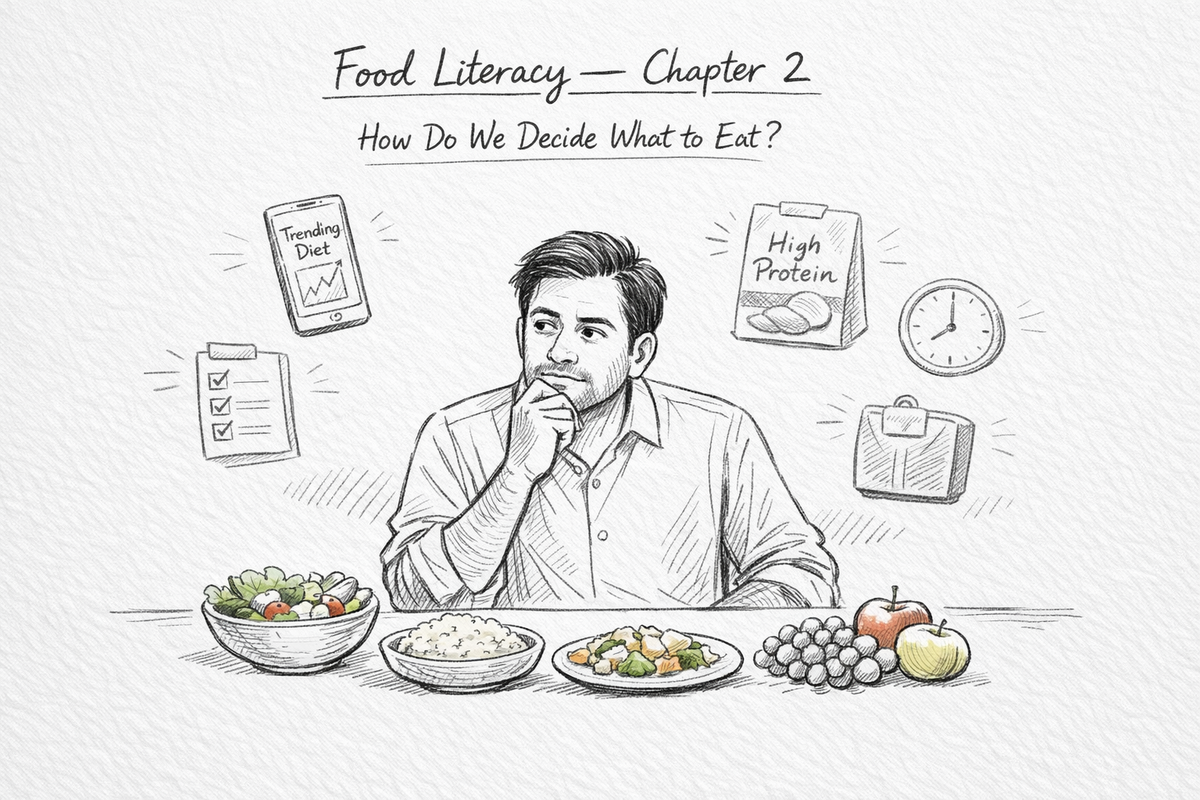
2.1 – A simple question most of us don’t explore
In the previous chapter, we looked at an important idea:
“Healthy food is not one-size-fits-all.”
Let’s now take a step further.
Consider a simple question:
“Why do I eat what I eat?”
Not what you eat,
but what influences that choice.
- Why oats for breakfast?
- Why protein powders?
- Why certain baby foods?
- Why specific “healthy” brands?
These choices often feel natural and routine.
At the same time, they are usually shaped by multiple factors.
2.2 – The system behind everyday choices
In financial markets, decisions are influenced by a structured system that includes:
- regulators
- institutions
- intermediaries
- information channels
Food choices, too, exist within a broader system.
A system that influences:
- what is available
- what is visible
- what is recommended
- what becomes familiar
Understanding this system does not change choices immediately,
but it can help make them more visible.
2.3 – Key influences within the food system
1️⃣ Food Production (Producers)
Food products are created by a wide range of producers — from small-scale kitchens to large manufacturers.
At scale, production often involves considerations such as:
- shelf life
- consistency
- availability across regions
- cost efficiency
These factors help make food widely accessible and convenient.
2️⃣ Communication & Packaging
Information about food reaches us in many forms:
- labels
- packaging claims
- advertisements
- expert recommendations
Words like:
- “high protein”
- “natural”
- “organic”
- “fortified”
are often used to describe products.
These descriptors help communicate certain qualities,
and over time, they also shape how food is perceived.
3️⃣ Social & Cultural Influence
Food habits are often influenced by:
- family practices
- community traditions
- peer recommendations
- digital content and trends
With the rise of digital platforms, food ideas can travel quickly,
sometimes moving from individual experiences to broader adoption.
4️⃣ Convenience & Lifestyle
Daily schedules and routines also play a role.
Food choices may be influenced by:
- time available for preparation
- ease of cooking
- accessibility of ingredients
In many cases, convenience becomes an important practical factor in decision-making.
2.4 – Observing the system in action
When these influences come together, they form a pattern.
A typical food choice may involve:
- something available at home
- something quick to prepare
- something familiar
- something recently heard or recommended
These factors often work together, sometimes without conscious evaluation.
2.5 – Different contexts, different needs
Food systems are often designed to serve large and diverse populations.
At the same time, individual needs may vary based on:
- age
- activity levels
- health conditions
- digestion
- environment
This creates an interesting dynamic:
- food is produced and communicated at scale
- but experienced at an individual level
2.6 – Traditional food perspectives
In many traditional food practices, choices were often influenced by:
- season
- local availability
- stage of life
- digestion and appetite
Food preparation and selection were closely linked to daily life and environment.
These systems operated with fewer intermediaries,
and decisions were often made within households or communities.
2.7 – A point of reflection
Looking at the broader picture, food choices today can be seen as a combination of:
- system-level influences
- personal habits
- environmental factors
- individual responses
This raises a useful question:
How do these influences interact in everyday decisions?
2.8 – Moving towards awareness
Understanding the system does not require immediate change.
It simply offers a way to observe:
- what influences a choice
- how that choice is formed
- what factors are consistently present
Over time, this awareness can make patterns clearer.
Key Takeaway
Food choices are shaped by a combination of systems, environments, and individual factors.
Recognising these influences can be a useful step towards making more informed and conscious decisions.
👉 What’s Next?
In Chapter 3:
“The Food Intermediaries: What Happens Between Farm and Your Plate?”
A closer look at the different stages food passes through before it reaches you—and how each step shapes what you finally consume.
Previous Next
Wisdom was never
one fixed recipe.
Continue exploring the food intelligence behind India’s traditional kitchens.
Explore the journal ↗