 Bag ◯
Bag ◯


Is There Really an Original Sathumaavu Recipe?
The Nutreat Encyclopedia of Sathumaavu | Chapter 1 – Understanding Sathumaavu | Article 3 of 7
One of the questions I am asked most often is,
“Which Sathumaavu recipe is the original one?”
Sometimes it comes from a young mother trying to choose the best food for her baby.
Sometimes from a grandmother who proudly believes her family’s recipe is the authentic one.
Sometimes from customers comparing ingredient labels of different brands.
For many years, I searched for that answer too.
I assumed that somewhere, there must be one original recipe from which every other Sathumaavu evolved.
But the more I travelled, listened, researched and handcrafted recipes over the last twelve years, the more I realised…
Perhaps we have been asking the wrong question.
The Search for the “Original”
When we hear the word original, we imagine a fixed recipe.
One ingredient list. One proportion. One method. One correct version.
That is how most modern packaged foods are made.
But traditional Indian foods were never created that way.
There was no cookbook that every grandmother followed. No institution decided what Sathumaavu should contain. No one person invented it.
Instead, it quietly evolved across thousands of homes, over hundreds of years.
Every family observed. Every generation adapted. And every kitchen left behind its own version.
What Never Changed
Although the ingredient lists were different, I noticed something fascinating.
The intention behind every traditional Sathumaavu remained remarkably similar.
It was never about adding the maximum number of ingredients. It was about creating a meal that felt complete.
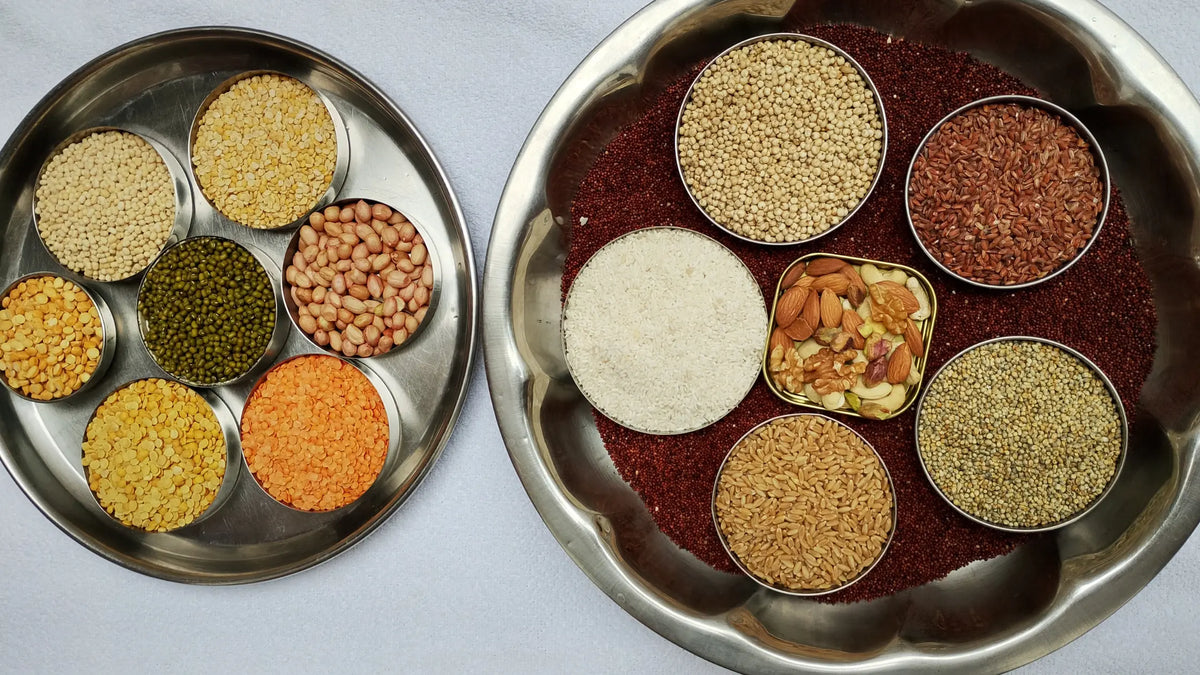
A thoughtful combination of grains. Locally available pulses. Nuts wherever they were traditionally used. Digestive spices. Ingredients that families trusted because they had seen them nourish generations before them.
The recipe changed. The purpose never did.
Perhaps the Original Was Never the Recipe… But the Principle
The more I studied traditional recipes, the more I realised that our ancestors were not preserving ingredients.
They were preserving an idea.
An idea that food should be:
✔ Balanced.
✔ Diverse.
✔ Seasonal.
✔ Prepared using traditional methods.
✔ Adapted to the person who would eat it.
Long before nutritional science gave us words like balanced diet, food diversity, or food matrix, our kitchens were already practising them through observation.
Not because someone taught them. But because generations quietly noticed what worked.
You can find a traditional Sathumaavu recipe here (if interested)
Every Recipe Reflected Its Own Land
I remember visiting a family in Tiruvannamalai whose Sathumaavu had almost no wheat — because their land grew native millets in abundance, and their grandmothers had built the recipe entirely around what the soil gave them. A few hundred kilometres away, a family near the Cauvery delta used three varieties of rice in their blend, because rice was what they cultivated, what they trusted, what they had always had.
Neither family had heard of the other’s recipe. Neither felt their version was incomplete.
Because it wasn’t.
A household with access to local pulses created another version. Another family adjusted according to climate. Another according to tradition. Another according to the person eating it.
None of these recipes were competing with one another. They were simply reflecting the land, the season and the people around them.
Perhaps that is why no two grandmothers ever gave me exactly the same recipe. And perhaps that is exactly how it was meant to be.
What Twelve Years of Handcrafting Has Taught Me
When we started Nutreat, I believed I would eventually discover the “perfect” Sathumaavu recipe.
Instead, I discovered something far more valuable.
Every family carried a story. Every recipe carried a reason.
Over the years, we have handcrafted more than 14,000 customised recipes for babies, children, pregnant women, elderly people and families with different nutritional needs.
Not one recipe was identical.
Yet every one of them followed the same principle:
The right food should match the person, the stage of life, and the purpose.
That, to me, is the real wisdom of Sathumaavu.
So… Is There an Original Sathumaavu Recipe?
I don’t think there is one original ingredient list.
And perhaps there never needed to be.
Because the real inheritance wasn’t a recipe.
It was a way of thinking. A way of observing. A way of adapting food to people instead of asking people to adapt to food.
Maybe that is why Sathumaavu has survived for generations.
Not because every family cooked the same recipe. But because every family understood the same intention.
And I believe that intention is the most original thing of all.
—
Jyothi Sri Pappu
Founder, Nutreat

Continue Reading — Next in Chapter 1
Why Is Sathumaavu Called by Different Names Across India?
A journey through languages, regions, and the stories hidden behind one of India’s oldest traditional health mixes.
This article is part of The Nutreat Encyclopedia of Sathumaavu — an original series on the food intelligence behind India’s most ancient multigrain health mix. Explore our Sprouted Sathumaavu →
Wisdom was never
one fixed recipe.
Continue exploring the food intelligence behind India’s traditional kitchens.
Explore the journal ↗