 Bag ◯
Bag ◯


When Was Sathumaavu Introduced First?
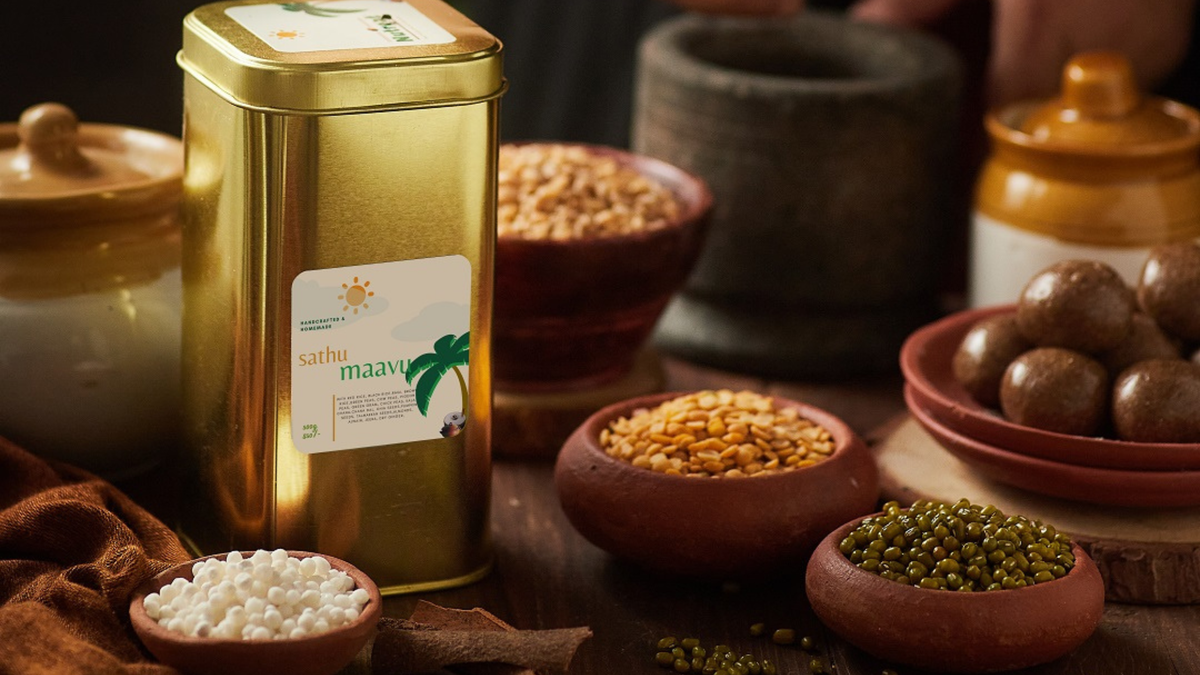
A Story That Began Long Before Science Explained It
I have often wondered who first thought of Sathu maavu.
Was she a mother worried that her child was too little to chew whole grains?
Was she a grandmother patiently roasting millets over a wood-fired stove?
Or was she simply a woman who observed nature carefully and understood that nourishment is rarely found in a single ingredient?
The truth is, I may never know.
Because Sathumaavu was never invented.
It was never introduced by one person.
It was never owned by a family, a community or a company.
It quietly evolved in countless kitchens across Tamil Nadu, passed lovingly from Patti to Amma, from Amma to Daughter, and from one generation to the next.
And perhaps that is what makes Sathu Maavu so extraordinary.
Because it was born not from science, but from observation.
Not from laboratories, but from lived experience.
Interestingly, my own journey with Sathu Maavu began only eight years ago.
One of our loyal customers, Ningku L, approached me seeking a Sathumaavu recipe for her seven-month-old baby. Until then, I had come across many traditional baby foods from different regions, but this particular Tamil tradition intrigued me deeply.
I remember asking her, "Can you prepare sprouted Sathumaavu for my li'll one?"
And that simple question opened the doors to an extraordinary world of traditional wisdom.
I began researching old recipes, speaking to mothers and grandmothers, understanding regional variations, observing ingredient combinations and slowly uncovering a tradition that had quietly nourished generations.
The more I learnt, the more I realised—
Sathumaavu was not merely a recipe.
It was a philosophy of nourishment.
And perhaps that is why my fascination with it continues even today.
The word itself is beautifully simple.
"Sathu" means nourishment.
"Maavu" means flour.
Together, Sathumaavu simply means: "Nourishing Flour."
But to Tamil families, it has always meant much more.
It is often the baby's first porridge after six months. The comforting bowl lovingly prepared by Patti. The nourishing drink given to pregnant women and nursing mothers. The wholesome breakfast shared by the entire family.
And while researching Sathumaavu, I discovered something fascinating. There was never just one Sathumaavu recipe just like Andhra Uggu.
A grandmother from Coimbatore would proudly say,
"This is our Sathumaavu."
A mother from Madurai would have a completely different recipe and say the very same thing.
Families in Tirunelveli preferred native millets.
Some households used generous amounts of Ragi.
Others added wheat.
Some roasted almonds and cashews.
Some avoided nuts altogether.
Every recipe was different. Every recipe belonged. Because families used what they cultivated.
Their local grains.
Their seasonal crops.
Their traditional preferences.
And most importantly,
They prepared Sathumaavu according to the child.
Their age.
Their digestion.
Their family's wisdom.
Sathumaavu was never meant to be fixed.
It was meant to evolve.
This, perhaps, is what amazes me the most. Our ancestors never spoke of proteins. They did not calculate carbohydrates. They did not know terms like micronutrients, bioavailability or Food Matrix. And yet, they designed recipes that beautifully combined grains, pulses, millets, nuts and seeds. Not because anyone taught them nutrition science. But because they "observed".
They observed which foods sustained energy. Which foods babies accepted happily. Which combinations supported growth. Which preparations felt balanced. Generation after generation, they quietly refined these recipes. Without research papers. Without laboratories. Without scientific terminology.
Today,
modern nutrition gives this wisdom a name— Food Matrix.
The understanding that food is not simply a collection of nutrients. It is the relationship between nutrients. The way they exist together. The way they support one another. The way processing changes them. And the way our body receives them. Whenever I read about nutrients & protein separately I cannot help but smile. Because I think of grandmothers roasting grains patiently. I think of millets drying under the sun. I think of recipes changing with seasons.
And I realise—
our ancestors practised Food Matrix beautifully, without ever knowing the term. They simply called it: "Good Food"
Even today, Sathumaavu continues to hold an important place in Tamil Nadu.
The Tamil Nadu Integrated Child Development Services (ICDS) continues to provide Sathumaavu as a complementary food after six months of age, extending nutritional support to children, pregnant women and lactating mothers. The importance given to this traditional food by public health systems beautifully reflects the trust generations have placed in it.
The policy also highlights something our grandmothers understood long ago—that the first thousand days of life are among the most important periods for a child's growth and development. Balanced nourishment during this period influences not just physical growth, but lifelong health and wellbeing.
Perhaps our ancestors did not know the science.
But they certainly understood the child.
People often ask me,
"Which Sathumaavu is original?"
After years of handcrafting foods, I have stopped searching for the original recipe. Because I have come to believe there is no single original Sathumaavu. There are only countless Pattis. Countless kitchens. Countless recipes. And countless acts of love, all created with one intention— To nourish thoughtfully.
And perhaps,
that is the real story of Sathu Maavu.
♡
— Jyothi Sri Pappu (Dedicated to our dear Ningku L)
Wisdom was never
one fixed recipe.
Continue exploring the food intelligence behind India’s traditional kitchens.
Explore the journal ↗