 Bag ◯
Bag ◯
What Does "Raw" Honey Really Mean? A Guide to Unpasteurised, Single-Origin Honey
By Jyothi Sri Pappu, Founder — Nutreat
We often ask whether honey is pure.
But perhaps there is a more interesting question worth asking:
💛 What actually happened to the honey before it reached your kitchen?
Was it heated? Was it heavily filtered? Where did it come from — one farm, or a blend from many? And when you open the jar, are you looking at something that still resembles what came from the hive?
These are the questions we started asking at Nutreat. And the more we looked into honey, the more interesting the subject became.
What Does "Raw Honey" Actually Mean?
The word raw sounds simple. But it isn't a universal processing standard with one precise definition that every producer follows in exactly the same way.
In everyday food conversations, raw honey generally refers to honey that has undergone minimal processing — honey that has not been intentionally heated or treated in the same way as highly processed commercial honey.
Unpasteurised is more specific: it means the honey has not been pasteurised through deliberate heat treatment designed to destroy microorganisms.
⚠️ But here's what these words don't tell you:
- Where the honey came from
- Whether it was sourced from one beekeeper or blended from many
- What the floral source was
- What happened between the hive and the jar
That is why, for us, the word raw was never enough on its own. We wanted to know the story behind it.
Why Does Honey Crystallise — And Is That a Bad Thing?
This is one of the most common questions we hear. Someone opens a jar of honey, finds it has become thick or grainy, and immediately wonders:
Almost always, the answer is no. Crystallisation is a natural characteristic of real honey.
🌿 None of these are signs of spoilage. They are signs that the honey came from somewhere real.
Why Is Most Commercial Honey Expected to Look the Same?
We live in a world where consistency is often mistaken for quality — the same colour, the same texture, the same appearance every time.
From a manufacturing perspective, consistency makes sense. But food doesn't begin with manufacturing. It begins with agriculture — and agriculture depends on seasons, soil, climate, rainfall, and geography.
🌸 Honey is connected to all of these:
Bees collect nectar from flowers → the floral environment shapes the honey → the season shapes the flowers → the region shapes what grows → and all of this shapes what reaches your jar.
So perhaps a better question than "Why doesn't my honey always look exactly the same?" is:
💛 "What is my honey telling me about where it came from?"
Why Nutreat Chose Single-Farmer Procurement
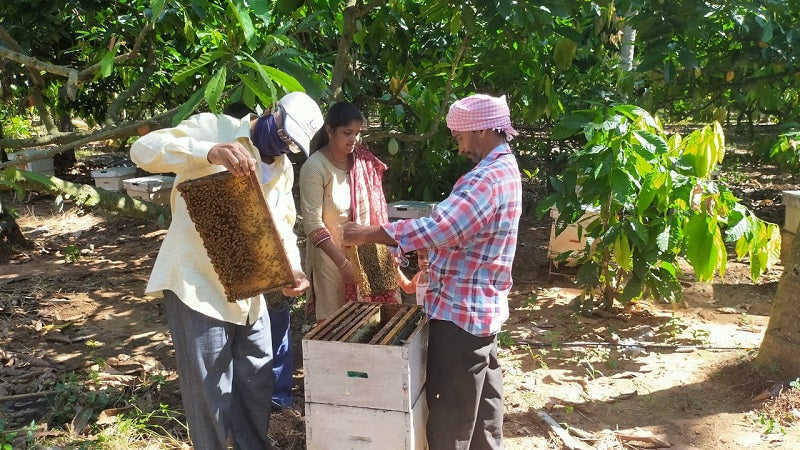
At Nutreat, one of the things we are most proud of is our relationship with farmers. Wherever possible, we procure directly from farmers rather than treating ingredients as anonymous commodities.
👨🌾 Knowing the farmer means we can ask real questions:
- Where was the honey collected?
- How was it handled after harvest?
- What is the primary floral source? Honey can reflect the flowers and plants available around the bees' environment, which can influence its colour, aroma and flavour.
- How does the honey vary from season to season?
- What does the farmer observe year after year?
These may sound like simple questions. But they change the way you think about food. A jar stops being just another product on a shelf. It has a person and a place behind it.
What Should You Actually Look for When Buying Honey?
If you're buying honey for your family, don't stop at the front label. Ask these questions instead:
🐝 Where does the honey come from?
Can the seller tell you something meaningful — a region, a farm, a beekeeper?
👨🌾 Who produced it?
Is there a real farmer or beekeeper relationship behind the product?
🔥 How has it been processed?
Has it been pasteurised or intentionally heat-treated?
🍯 Why does it look the way it does?
Clear and liquid ≠ better. Crystallised ≠ spoiled.
📋 Does the seller explain what they actually do?
Transparency is often more useful than beautiful packaging.
What We Chose for Nutreat — And Why
When we decided to bring honey into the Nutreat range, we didn't want to create another product simply because honey sells. We wanted it to fit our philosophy.
🍯 Procured directly from a single farmer.
🌿 Kept unpasteurised.
💛 Handled with as little interference as possible.
Because the Nutreat philosophy has always been about respecting the ingredient. Whether it is a millet, a lentil, a seed — or honey — we keep coming back to the same question:
"Raw" Is Not the Most Interesting Word After All
The more I think about honey, the less interested I am in the word raw by itself. What interests me more is traceability.
🌿 What traceability really means:
- Knowing where something came from
- Knowing who produced it
- Understanding how it was handled
- Accepting that natural foods can change
- Being honest about what we know — and what we don't
Food becomes different when you know its journey. A grain is no longer simply a grain. A lentil is no longer simply a lentil. And honey is no longer simply a sweetener.
There is a farmer. There are bees. There are flowers. There is a season. There is a place. And finally — there is a jar sitting in someone's kitchen.
✨ That entire journey matters.
🍯 Our Honey, the Nutreat Way
Our Raw Unpasteurised Honey is procured directly from a single farmer — unheated, unblended, and unhurried. Natural character intact.
→ Explore Nutreat Raw Unpasteurised HoneyAnd perhaps the next time you see honey crystallising in your kitchen — pause for a moment.
Maybe the honey is simply reminding you that it came from somewhere.
Good food should make us curious about its journey.
— Jyothi Sri Pappu
Founder, Nutreat
Wisdom was never
one fixed recipe.
Continue exploring the food intelligence behind India’s traditional kitchens.
Explore the journal ↗